Service Design

April 2026
Asama P.
Thongthod K.
Rawisara L.
UX/UI Lead
UX/UI Designer
UX/UI Associate (Me)
Figma, Figjam
Conducted and facilitated the service design workshop, guiding the cross-functional team through persona and journey mapping.
Summarized the workshop findings into the persona journeys, shared emotional themes, and opportunity map.
Drove the next-step planning, defining the follow-up workshop.
Running this workshop changed how the cross-functional team approached the problem, replacing assumption with a shared, evidence-based view of who they were actually designing for.
👬👬
👏
➡️
Salary Hero's core EWA product was being used heavily, but usage patterns varied wildly between users, and we didn't understanding the emotional and situational context behind these behaviors. Some withdrew rarely and used the full amount instantly; others withdrew small amounts multiple times a month.
We built two behavioral personas from real usage patterns rather than assumptions, so the team would design for the actual extremes in the user base instead of an average user that doesn't really exist.
Aom — the independent emergency user
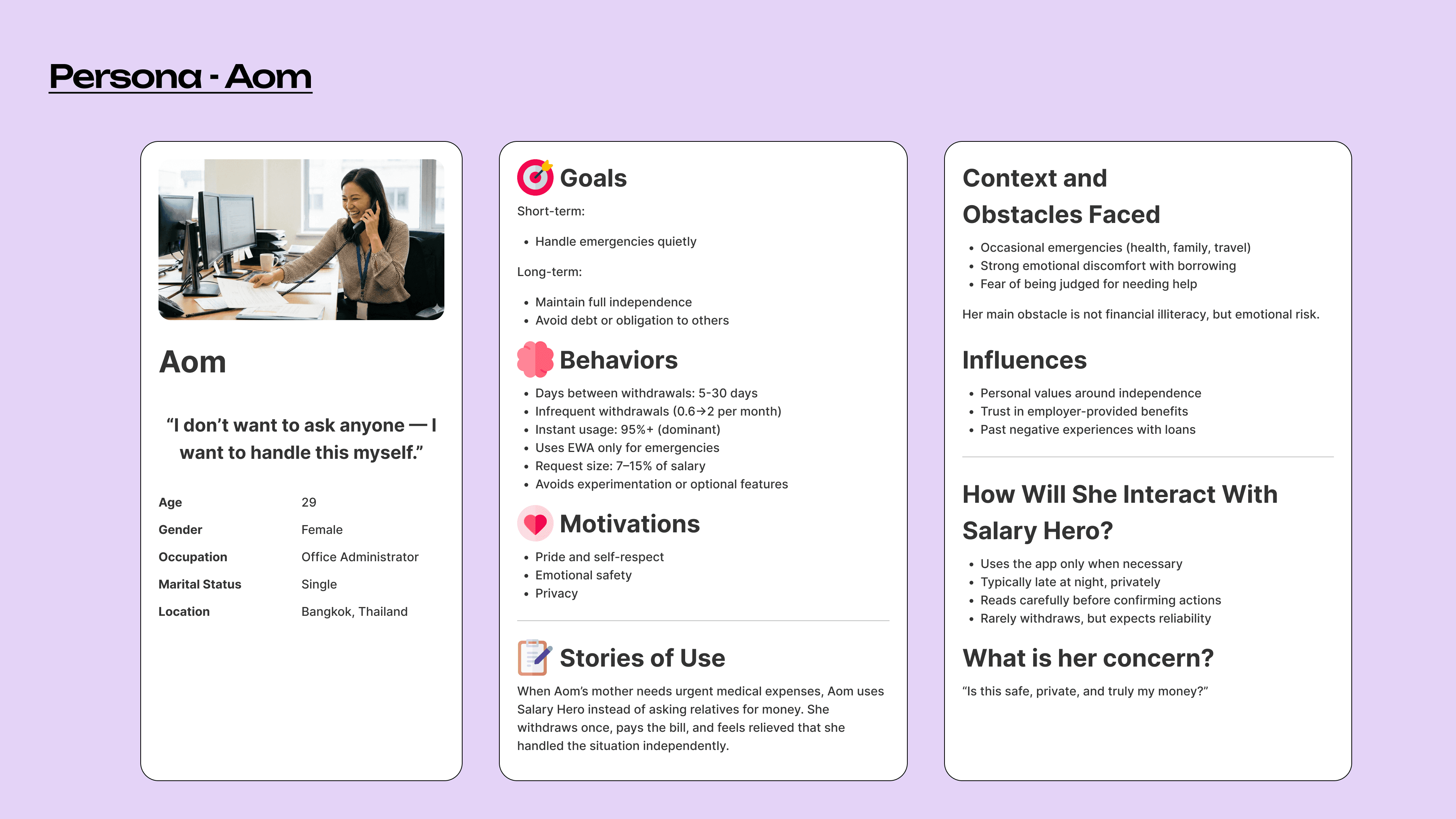
Aom's Scenario
🏥 💊
Pichai — the recurring stretch-to-payday user

Pichai's Scenario
👧 🏫 💰
We split the workshop into two groups, Aom's scenario and Pichai's, so each team could focus on getting one journey right rather than generalizing across both. For each persona, we plotting their emotional state and pain points at every touchpoint along the way.

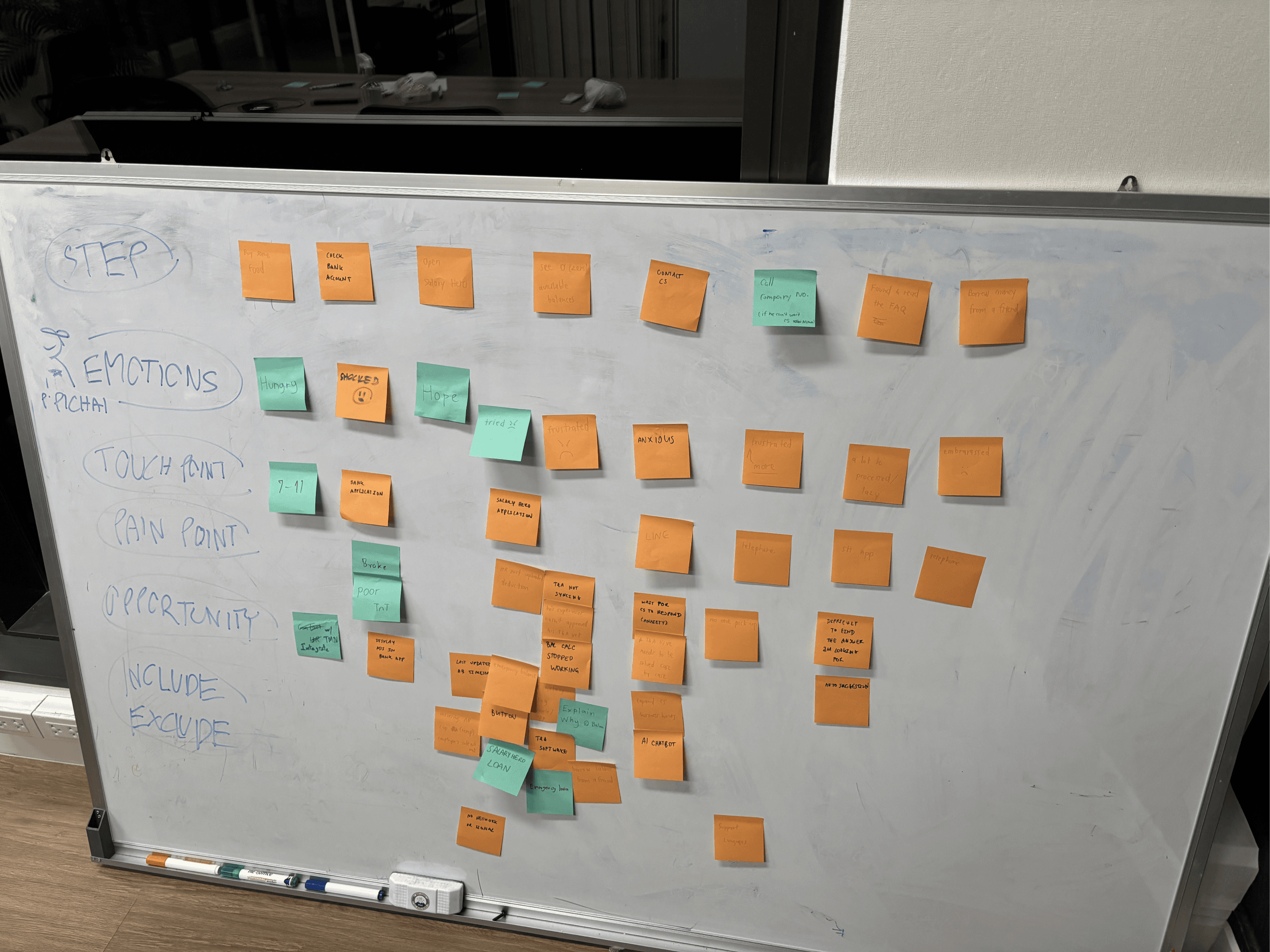
Afterward the design team consolidated both group's work into the master map tracking the journey through three stages — problem arises, trying to solve it, and resolution.


Aom's story — positive ending
Mother falls sick, needs urgent hospital treatment
Goes from neutral to panicked, then worried and stressed arranging leave and the hospital bill
Withdraws through Salary Hero, pays the deposit, and feels relieved she handled it herself

Pichai's story — negative ending
Short on cash after paying his child's tuition
Opens the app hopeful for his usual weekly withdrawal, but his available balance isn't showing
Tries FAQs, customer support, and calling in; ends in disappointment and embarrassment, borrowing from a friend instead
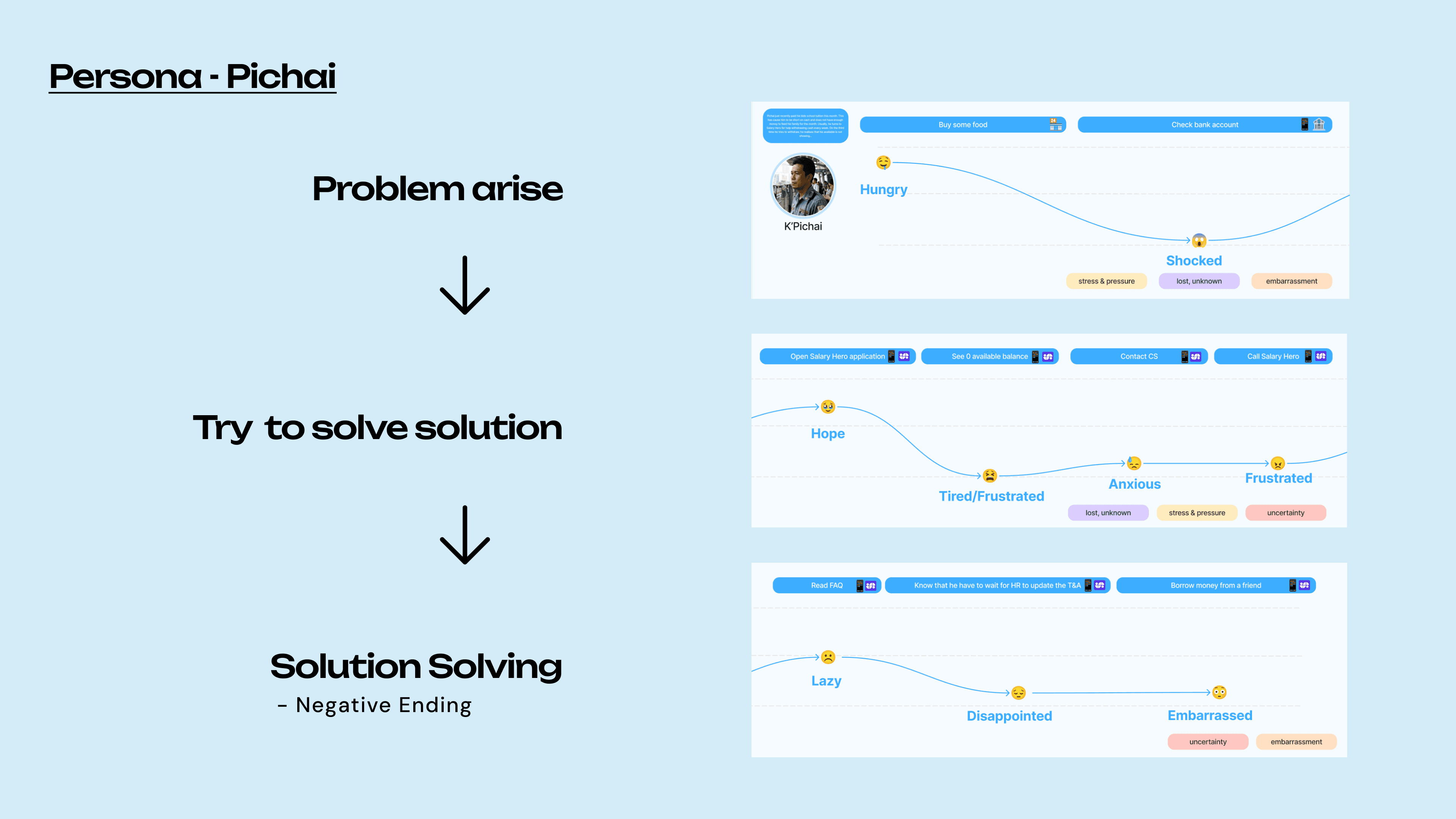

Despite very different behaviors, both personas' journeys kept surfacing the same four emotional themes, telling us the fix wasn't just one feature, but a combination of product changes and human support working together.
🤯
😓
😳
😞
We mapped opportunities separately for each persona, then split them into two buckets: what the product could do, and what Salary Hero's operational staff (CS, HR partners, marketing) could do to support users in the moment.

For Aom (privacy, independence, big-ticket emergencies):
In-app communication about features
A chatbot for emergency consultations
HR-permissioned, no-internet-required withdrawal
Insurance and savings products
Ability to access a larger emergency amount when truly needed

For Pichai (frequent small withdrawals, balance anxiety):
Clearer available-balance information and update logs
A more reliable internal time-and-attendance integration
An emergency fund with a higher available cap
Faster customer support response during business hours
A few findings cut across both personas and shaped how we prioritized afterward.
Not every fix needs to be a feature. We identified four non-product workstreams that could reduce user distress immediately, without waiting on engineering.
We closed the workshop with idea generation and dot-voting across the cross-functional team to surface what mattered most.

We also mapped each top idea against what it would mean for Salary Hero as a business, using a 2×2 matrix plotting business value against user emotional comfort.
Emergency AB came out on top in both exercises: the team's #1 vote and one of the strongest business case. For the user, it helps their financial needs in the short term and makes them feel more comfortable. For the business, more users accessing funds means more fee revenue, though it also carries more risk that some users won't be able to afford to pay it back.

The top-voted idea, Emergency AB, became the seed for a three-tier product structure that scales with how serious the need is
Tier 1 — EWA Advance — up to 50% of earned wages
Tier 2 — Emergency Loan — up to 100% of net earned wages
Tier 3 — Extended Emergency Loan (in partnership with a bank) — up to 150% of monthly salary, low APR (12–18%), automatic payroll deduction.
To pressure-test the concept, we walked it through Pichai's actual scenario:
Pichai earns ฿15,000/month
On June 7th he needs ฿10,000 for rent due June 10th, but his available balance is only ฿3,500
He requests an Emergency AB; his HR contact reviews and approves it
He pays rent on time, without missing a payment cycle or turning to an informal lender
The structure has clear upside, but also real exposure we flagged early.
No credit check required
No interest at the base tier
Automatic payroll repayment removes the risk of missed payments for both the user and the business
Could functionally resemble a loan product even though Salary Hero isn't a licensed lender
Requires capital upfront
Partner companies may not all agree to participate
Revenue exposure if employees don't repay
Beyond the headline tiered product, the workshop surfaced several smaller bets worth tracking.
This research was the starting point, not the finish line. We lined up a follow-up workshop and two validation tracks to test our assumptions against real data and real conversations.